Posts

Showing posts with the label weapons

Last Weapon: The Human Body

Image
My first thought was to title this post "The Empty Hand", but it would not have really suited the content. We know I love kicking, so"Hands and Feet" would have been more accurate, right? But then I would probably get reminded of the elbows and knees... And someone else might then bring up the head, shoulders and hips... As martial artists we often take for granted, especially after some years of training, how much time and effort was put into making our bodies into weapons. Sure- you have the contact areas that have to make contact with the target, but we all know that an inefficient use of the body as the delivery system may cause the fist or foot to never even reach its target... Striking, grappling, defending- all of these actions make up the art of fighting that we practice. Unlike all other weapons in our arsenal, this particular weapon can improve with regular use. It can get stronger, more durable and more effective. ...
Having fun

If it isn't fun you won't feel like doing it, right?

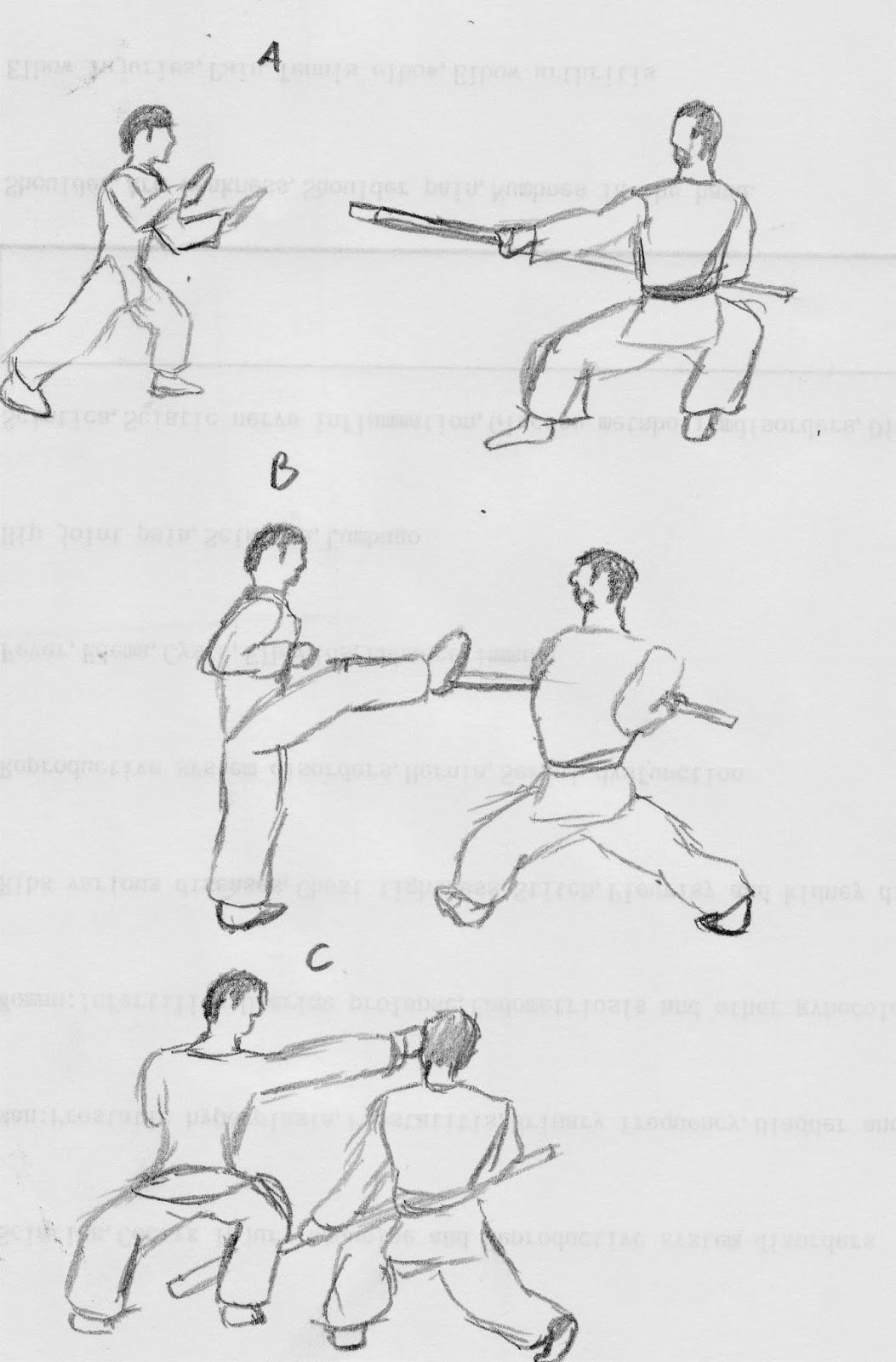
Dealing with long weapons using kicks.

Image
Most martial artists know that an opponent using a long weapon like a staff, baseball bat or sword is at a disadvantage as soon as you have managed to get past the weapon itself and close to him. Most of us are more comfortable with using our hands to manage the weapon and stepping past it to get to the opponent. Most adversaries would most likely expect you to do that as well... Now the major advantages of using a kick like the crescent kick I am showing in the sketch are the following: 1. It uses a limb more powerful than the arm; 2. It leaves both hands free to attack; 3. It opens up a path for you before you bring your body in range; 4. It gives you the element of surprise on your side. To me- a weapon that is held poised and pointed toward me is a bigger threat that one that is being swung. A swinging weapon can be timed and often clears the way for you to move in by itself. A poised weapon, however, is a trap! The crescent kick is a good way to c...

My Kusarifundo

Image
I'll admit that I don't practice with this weapon much. Recently I decided to make the chain longer for extra reach. For those who do not know this weapon it is a chain with an iron weight at each end. The weights are flung at the opponent to stun him/her while the chain itself is used to ensnare or as a garrot. This particular weapon is associated with Ninjutsu, but Chinese martial arts have similar weapons using blades or weights at the end of ropes or chains. As you can see from the video I have some trouble controlling this weapon. If anyone has a better video to post- you can email it to me at boshoffm3@gmail.com.

The Nunchaku

Image
Known to some as a part of the Okinawan Karate arsenal and to others as the Chinese two-sectional staff this is yet another weapon which is not extremely effective, but that can with the appropriate skill, surprise and incapacitate adversaries. Be sure to have attacks ready and available for when you do have the room to use the waepon to its fullest potential or when you are in a close quarter situation or confined space that does not allow for flailing movements. The attacks are not swinging attacks, but rather whipping attacks with the force thereof concentrated on the point of impact. Should the force not be concentrated like this the result is usually the user hitting himself. 

Jian Form

Image
The Chinese sword is said to be mainly a stabbing weapon. It springy, supple blade remainds me a lot of the rotor blades of a helicopter, though. And I have seen slicing attacks being dealt with it. In attack and defence the is a weapon requires speed and accuracy. Like most Chinese weapons- the jian is useless in the hands of an unskilled user. 

Sword Form

Image
Swords in the Chinese and Japanese systems can be classified in two categories, cutting swords and stabbing swords. Although slicing as well as stabbing attacks are performed with both the design of the sword determines the preferred form of attack. A strong curved blade like the Chinese "Tao" knife (actually it is a sword, but the Chinese insist on calling it a knife) and the Japanese Katana makes it suited for cutting attacks. Having learnt to sink my chi into descending blows as used in Hsing-Yi Quan ( a form of Wudang Kung Fu) I incorprate these descending attacks into my katana form too.  

The Sai

The Sai is a weapon which became known to the West when it was found being used on the Ryukyu Islands during the 1920's. Generally recognised as a "karate weapon" its techniques strongly resemble karate techniques. The Sai is a bludgeoning as well as a stabbing weapon, with prongs that are used to trap weapons. Although it can be used as a single weapon, the Sai is usually seen used in pairs. This allows for the practitioner to incorporate the teachings of Musashi's Nito Ryu- style of sword fighting. Twirling movements during form practice improves dexterity. Before thediscoveryof the Sai on the Ryukyu Islands the Samurai in Japan had a truncheon with a single prong called the Jutte . It is very likely that the techniques taught by karate schools nowadays would employ Jutte tecniques as well, especially when the weapon is used against a sword.

The Long Staff

The staff can be used for thrusting attacks, but practice mainly involves swinging blows. The grip allows for a section between the hands which is used for blocking and a long section which is left free for attacking. A defence with the staff would involve twisting the hips and turning the torso to avoid straight thrusts to the torso, putting the staff between the head and a descending attack and turning to place the staff between the body and horizontal swinging attacks. Attacks to the legs are dealt with by raising the target leg clear from attack, sweeping the staff downward or a combination of both. The staff is further an excellent tool to strengthen the wrists and grip and to train the body for throws.