Posts

Showing posts with the label kata

What if Sensei Iain got a look at Kung Fu?

Image
If you have not yet seen Sensei Iain Abernethy's videos then now would be a good time to start. The video below would not mean as much to you if you have not been studying Karate for at least 3 years. In some styles it may take even longer to see the katas that he discusses.  What many of us experience when practicing kata is that the movements do not make any sense. Here in Bassai Dai for instance we have two blocks that are not followed by any kind of visible attack. So- what are we to believe? That the opponent will just walk away if he sees that you have blocked the only two punches that he was willing to give to this fight? That is where Sensei Iain helps a lot. After watching the first of his videos I have made a point on finding out what he has to say about the obscure movements of every new kata that I have learnt. Sensei Iain does not do Kung Fu, though. I have thought that I have Kung Fu pretty much figured out. On Kung Fu pages and in Kung Fu groups online you may get el...

The Mi Lu Kata- Learnt from a book

Image
I admit that Ninjutsu fascinates the hell out of me. Thanks to Stephen Hayes and Ashida Kim I have been able to learn sword techniques, shuriken throwing and of course- some interesting unarmed fighting techniques.  The Mi Lu Kata- or Lost Track teaches techniques that rely on misdirection to get past an opponent's defense in a fight. I am not certain whether this kata has any ties with the Mizongyi (Lost Track) Boxing that is attributed to the legendary Huo Yunjia. I am not even certain whether this kata exists outside of Kim's school on Ninjutsu. I have however, had a lot of fun learning it and have started practicing it again. With the details about Ninjutsu having become even more uncertain in this day and age than how they were 40 years ago I doubt that anyone is able to say for certain exactly how Ninjas used to fight in the 17th Century. What I am certain of, however, is that these techniques do not seem like fighting techniques used by Japanese warriors at the time. I c...

Tongbeiquan: Damn this one is hard!

Image
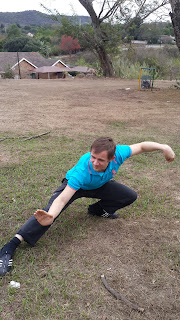
Learning this form was not much fun as the first video that I have watched on this featured a woman doing the form at top speed. I have already accepted that the way your form looks depends partly on who you learn it from. Not much further away on the internet, I have found this variation: Nonetheless- I enjoy having this form in my program. I have always wanted a kata that features a hurricane kick. :) The number of katas I know now stands at 27. I have also created 8 forms of which I plan to keep 4. 3 of them got discussed in earlier blog posts. Even though I have gone and learnt this many katas I think that regularly practicing the katas that you know is more important than learning new ones. Sure- every once in a while you would pick up a new technique from a kata that you have not yet practiced. Still- it will only become of any use if you have practiced it enough. Well... there is only one more form that I would like to show you, but that will have to wait for next week. Now I ha...

My Nanquan Form

Image
My introduction to Kung Fu was the 48 Form Set of Taijiquan that was created in the 1950's. I have only gotten the feel of actually channeling qi into martial arts movements, though, when I learned Shaolin Kung Fu. That had led among other things to me creating a custom made Taijiquan form (The words "form" and "set" are sure to confuse a lot of people who do not study Kung Fu. Since Karate people call katas "forms", however, I also call Kung F sets "forms"). I was satisfied to have my Taijiquan form for practice of a Wudang based martial art and the 5 Ainimal Set as a faorm for practicing an art from Shaolin. Then- as you know- I have started writing my book on Kung Fu forms. So- I have looked through my collection of martial arts material and found this video from a while back.   Now... for a long time I was happy to practice my 20 katas from Karate, rotating them in groups of 2 to be practiced two days every week, but then I have decided t...

Taking time to learn

Image
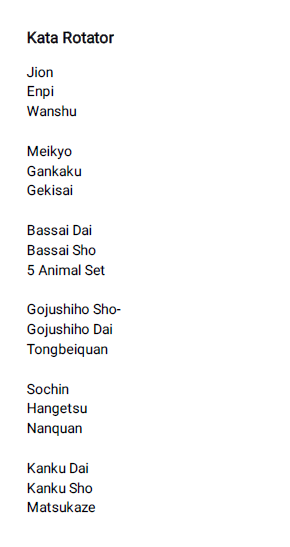
Hello, everyone.  You see this list below? This is what I use to make sure that I practice all the katas that I have learnt. Saturdays are easy. On Saturdays I practice all 5 Heian katas and all 3 Tekki (Naihanchi) katas from Karate. On Sundays I practice Taijiquan and my kata and fighting practice is on Tuesday and Thursday mornings. It used to be two katas per morning just before I finish my workout, but- as you can see- the katas have now been put together in groups of 3.  3 of these katas are brand new to me and there are also some old katas of mine that I have decided to brush off and add to my list for regular practice. One kata that I have really enjoyed learning is Gekisai Ichi from Goju Ryu. I just list it as "Gekisai" in my Kata Rotator because it is the only Gekisai that I will be practicing- well... for now... The kata first came to my attention when Jesse taught it to another martial arts Youtuber in one of his videos. Then- when one of my martial artist friends ...

New Book Coming: Taolu Practice for Kungfu

Image
It has been a while since I have sat down to write any book. You may have noticed that I even neglect my blogging nowadays...  I have, however, had enough time to think about what to write about next. I have chosen to write about form practice in Kungfu. In our general language we use the term "forms" to refer to those sequences of movements that are performed without an opponent. Kungfu people, however, call these sequences "sets". The word "forms" are usually used by Karate people when they refer to kata. In Karate the Japanese term kata is used while the Chinese term taolu is used by Kungfu practitioners. Kungfu forms are generally longer than Karate forms, though. In Karate we find that the traditional styles follow a very conservative approach to teaching and practicing forms.    During the 80's some more progressive styles of Karate have appeared with acrobatic forms- performed to music, no less.....

The Striking Form

Hello again, everyone! This video shows the form that I had created for my book on striking. It is actually very straightforward and basic, so I did not really see the need to explain its applications at first.  Later on I decided to break this form down in later posts anyway because: 1. Along with the movements in any form comes the principles on which those moves are based- and knowing those principles are actually more important than knowing the moves themselves; 2. I have so much fun making those shadow-clone gifs anyway. Where the previous form was made to give you the feel of different ways of defending against attacks, this form is meant to give you an idea of the different ways in which you can attack with strikes, punches and kicks. In the application of these movements it is not necessary for the opponent to be attacking at all. From a moral point of view we can assume that the opponent has threatened to attack or is about to attack. ...

The Defense Form

Image
Hello, everyone and welcome back.  Today I introduce you to the form that appears in my book on Defense. If you have read the book before you may find it familiar. If not- it is still a good time to join us since I have begun posting breakdowns of the forms and their applications. Although it is called the "Defense Form" for ease of reference the form does contain attacks. Every block or sidestep here is shown with an attack that immediately follows it.  When I decided to document Wenhsiuquan techniques I have especially paid attention to this book, because much of the difference between Wenhsiuquan and its sources lies with defense. Wenhsiuquan drew upon Karate, Kung Fu and Jujutsu. Jujutsu does have blocks and parries, although it is more known as a grappling art. Of these 3 martial arts Karate has the most blocks and parries that I know. I have not yet seen any Kung Fu forms, for instance that contain a rising forearm block ( age uke ). Su...

Now I know 14 katas!

Image
I have been working a lot on my speed lately. At the dojo Sensei has told us that competition fights are now being won by those who can cross long distances the fastest to deliver a gyakuzuki. Having taken it upon myself to give spectators a bit more to watch than just a gyakuzuki contest I have taken it to heart and streamlined my kicks as well. Fact is- there are some pretty fast people out there. Nonetheless- timing beats speed anytime, so we wil not get obsessed about it. Amidst the hustle and bustle for the last tournament I have managed to learn 2 new katas, though. Having left karate all those years ago and having moved through 12 katas when I joined the other dojo in 2014 before leaving again have not really enabled me to settle down and learn new katas. Besides- I have been busy working on WSKF basics for the last couple of months since my joining, since it needed a lot of tuning up. Nonetheless- the fates were kind. Now I have Gojushiho Sho and Kanku Dai. Th...

Found a new lever!

Image
Working on my first book I focussed a lot on the basics of grappling, but have far from exhausted the subject. Most techniques I have explained used a manipulation of the wrist or leg. One other lever I did give brief attention to was the philtrum- the spot right at the bottom of the nose.   In Judo our opponent wears a gi with a belt, sleeves and lapels that can be grabbed. In actual fights outside the dojo (which you should of course not actively pursue) we do not have those handholds. We dn't have rules either. Last night- surfing Youtube- my attention was brought to the head. This is how it happened: I have recently learnt Gojushiho Sho from my Sensei. For those of you that don't study Japanese Karate this is a kata that is taught at senior level. It is officially the most advanced kata I know. I have supplied a link to a video of this awesome kata below: https://youtu.be/FxyScLnqdIg You will notice the quick open hand thrusts that make up a lar...

What does your kata do for you?

Image
I have found out only very recently that we have a long weekend coming up- so my self defence group has ditched me to head off on vacation. I was promised, however, that I will soon get to make a demo video. So- I forgive them. Fortunately I had this post to write as well-  In this blog's beginning I have written a post about form practice in Wenhsiuquan saying that I use three different types of form in training: 1. Power Form; 2. Combat Form; 3. Energy Form. These 3 types of form were not developed or invented by myself, but were already there for me to be used when I embarked on a lifetime of martial arts study. The very first kata I have tried to learn was a Shukokai kata called Rohei . It is in Tommy Morris' book on karate without any explanatory notes or those useful arrows that you find in books about kata. At 14 I joined the Shukokai dojo in my town and I got a proper introduction to kata. Before the year had passed I have learnt Taikyoku...

A form I have been working on...

A while ago somebody told me that the five Heian/ Pinan katas of karate were one one kata. Since that time I have been practicing all five Heian katas as one. Now- you know that I like modifying the forms. Since my last post I have been trying to get Taijiquan movements to replace the karate techniques in all 5 katas. It was not easy. This video shows the rough draft that I have been working on. I think the final product will have that spinning blow from Heian Sandan left out... It does not feel very Tai Chi to me...

Now it's Heian Sandan's turn... And- My book is going to get printed!

I am happy to say that my second book will soon be printed- in my hands. :D Hope you guys enjoy it. Meanwhile- I still enjoy training. I was very glad to get a nice response to my last post that I decided to share my work on this kata as well. The karate form is from Shotokan. Lots of us know it. It starts with a series of blocks, goes into that rotating escape from a wrist hold and at the end there are those two punches for someone grabbing your from behind, right? Now... The kungfu version was tricky. Initially I thought that I'll find everything I need in Wingchunquan, but I have never found a rotating escape in any Wing Chun forms. So- I borrowed "Snake Shoots Across Valley" for the spear hand. Kept the escape and for those two attacks to the rear I added two doses of "Tiger Bites it's Back". Now- Taijiquan seems to interchange nicely with karate for some reason... I inserted "Snake Creeps Down" with a rotation after s...

Giving Bassai Dai a makeover

I am not going to pretend to be the first one to do this. In fact- if you have seen more than one style of karate you'll find that different versions of a certain kata often exist in different styles (and some styles have kata that others won't). I decided, however, to adapt one of my favourite Shotokan katas so that it can be practiced in two of my other favourite martial arts- Shaolin Kungfu and Taijiquan. With each video I'll tell you a bit of how I experience each art:   1. Bassai Dai in Karate Mode: I was told that "Bassai Dai" is Japanese for "Storming the Fortress". It was my favourite kata in my Shukokai days and I like the Shotokan version as well. When I began learning karate I had to learn the basic blocks and punches. Each punch and block had its own Japanese name and also each stance. Stances and blocks/ attacks got combined later on, but the lessons for white belts were broken up into these bits which made the technique eas...