Posts

Showing posts with the label defense

Defense Form: Movement #5- Block in Cat Stance and Reverse Punch

Image
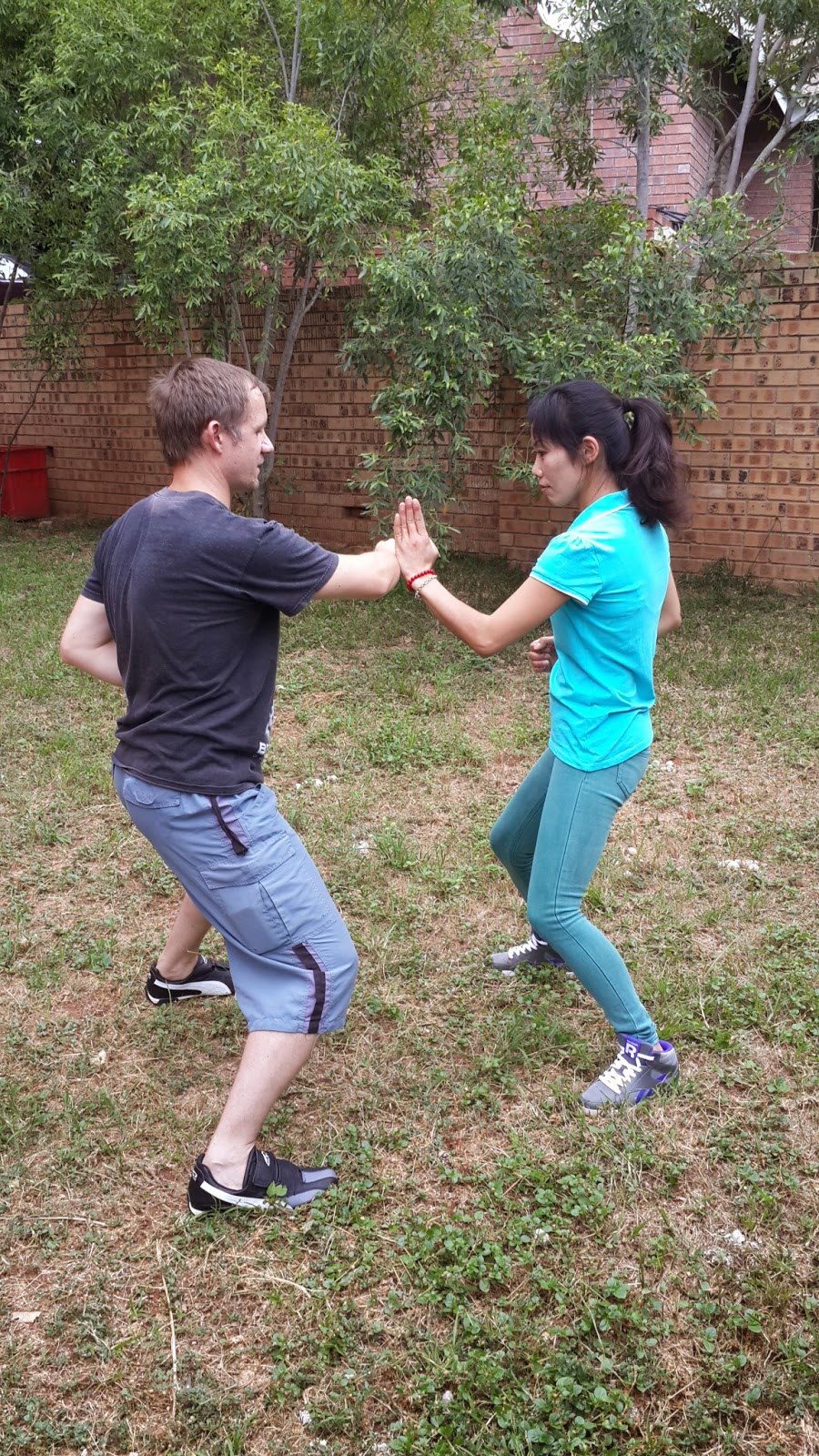
I could probably have called the movement "Tiger Bares Teeth and Black Tiger Steals Heart" because that is more or less what Kung Fu students would call it. Still- the stances featured in this movement and the techniques used are common to both Karate and Kung Fu. They can be found in Korean Arts like Taekwondo as well. The block itself here does not use the tiger claw hand form that is seen in Shaolin Kung Fu. If you want to use it, however, I really have no objection. To me the fingers spread apart like in the tiger claw form indicates a readiness to grab the opponent's wrist upon blocking it. In Kung Fu the tiger claw can also be used to dig into the punching arm's bicep, disabling that arm from further use in the fight. What I have done here, however, is a simple block and a punch. Really straightforward, actually. The stuff one teaches white belts... Nonetheless- I thought it a good idea to summon a shadow clone to show you some of the applications to th...

Defense Form- Movement No. 3: Bursting through the attack

Image
Hello again, everyone. Today's move actually pretty much speaks for itself. Still- it helps o look a bit at its finer details. I have never seen any kata or form that shows any of the defensive footwork that we find in sports martial arts. In competitions we often see fighters retreating while they block or parry and shifting forward again to counterattack. Still- we don't see this happen in our katas. Well- in Kungfu's taolu- as they call their katas we do find moves for withdrawing and sidestepping as well as for advancing. Still- the majority of moves in these forms are advancing moves. Moving forwards into an attack looks like suicide most of the time. Still- almost all of the forms we see seem to prescribe it. Why would anyone want to do it? Well- here is my answer. Take it or leave it. Sure- it is probably the safest to first evade your opponent's attack before attacking, but you practice martial arts on a regular basis, right? ...

Defense Form: Movement 1- Double block and Palm Thrust

Image
Hello, everyone and welcome back! Today we are looking at the first movement that features in the Defense Form. The nice thing about blocking and striking moves in forms is that they are at least obvious. You can easily see what they were meant to do and are not really open to other possible interpretations. Well- at least here you are getting the discussion from the creator of this form, so you really don't need to exert yourself trying to guess what I was doing. I'll tell you.  When I first took up Karate I have, like many white belts, learnt to block a punch and then to counterattack. That was basic practice and prearranged sparring drills for you. Later on I found out the hard way that landing a block did not always put you in the clear. In free sparring situations your opponent does not come at you with just one punch. In fact, he does more than just punch then... As I always did back then, I went and done some research. It was a while until...

The Defense Form

Image
Hello, everyone and welcome back.  Today I introduce you to the form that appears in my book on Defense. If you have read the book before you may find it familiar. If not- it is still a good time to join us since I have begun posting breakdowns of the forms and their applications. Although it is called the "Defense Form" for ease of reference the form does contain attacks. Every block or sidestep here is shown with an attack that immediately follows it.  When I decided to document Wenhsiuquan techniques I have especially paid attention to this book, because much of the difference between Wenhsiuquan and its sources lies with defense. Wenhsiuquan drew upon Karate, Kung Fu and Jujutsu. Jujutsu does have blocks and parries, although it is more known as a grappling art. Of these 3 martial arts Karate has the most blocks and parries that I know. I have not yet seen any Kung Fu forms, for instance that contain a rising forearm block ( age uke ). Su...

Better reflexes or responses

Image
Those of you who are members of our group Martial Arts Forums, may have noticed Abisha Soans in our midst. This bright young girl has taken huge interest in the group and is not shy to ask questions. This week I received notification of her question about reflexes in my mailbox. She soon had no shortage of answers. Some of the advice Abisha got came from a very scientific approach. Some of it came from a more practical perspective. With me, martial arts training is mostly about first hand experience. Now- before I go into my long explanation of my answer to her- let's just distinguish between reflexes and responses. The former relates to involuntary movements of the body or part thereof in response to external stimuli. That includes blinking or that familiar kick of the leg in response to a doctor's hammer. The latter refers to the trained responses we apply to situations. These movements are far from involuntary, but through conditioning and repetitive training...

Thank you, Shairley and Vic! :)

Image
 I am actually busy nursing an injured leg back to health and now find myself at that stage where it is feeling a bit better and I am itching to get back to training. I will, however, stick to light Taijiquan practice for this next week and take up the heavy stuff the week after. Meanwhile- I am working on the second Wenhsiuquan book. This one is about defense. Instead of Chen Feng and Chris I got help from another couple. Vic- who you will not be seeing in any photos, because he operated the camera- and Shairley Yang- volunteered to help out with some of the photos. By some- I don't mean just a few, mind you... Shairley is well known here for her cheerful- and playful nature and we got a lot of it during the shoot. She actually made this a lot more fun than what I thought it would be. I hope you all train well. I'll be sure to let everyone know when this book is finally ready. Have a great week!

So you've blocked... Now what?

Image
I'm sure a lot of readers will remember how Daniel-San spent days painting a fence, waxing a car,  sanding a floor and lacquering a wall in order to learn how to block.  Fact is- I loved my blocks as a Shukokai white belt. Despite having been shown the simple slapping block and pressing block for kumite I wanted to use uchi uke and all those other cool blocks. And yes- I love Bassai Dai  too. Later on (in my case as 1st kyu brown belt) I realised that my obsession with blocking was hurting my karate. Sure- I could deflect blows, attempts to grab me and the odd finger poke at school, but still sucked at kumite. The main reason for this was simple. Blocking itself does not do much (unless you are a master who is able to break someone's arm with that block- people like that exist!)- Blocking has to be followed by a counter-attack! I'm sure many readers have also come to this realisation early on in their training or were taught this universal t...

Range

Image
Depending on the type of competition or whether it is a real fight or competition it is very important to know what  distance is close enough to touch the opponent and what range is close enough for some real damage. This fight probably comes to anyone's mind when we think about fighting a taller opponent. The Legendary Musashi Miyamoto is said to have fought a samurai called Kojiro. Kojiro's advantage in combat lay in his sword, which was longer than what was the norm at the time. Musashi, however, remedied the situation by beating Kojiro to death with a wooden oar which he had modified to fight with. I am not going to deal with projectile weapons and guns here. Everyone knows that the range of those is far longer than even a 7 foot staff can muster. What I will discuss, however, is what assumptions about range are wrong- and even dangerous- and which approaches deliver the best results.  First of all- It is not always a good idea to stay out of your o...